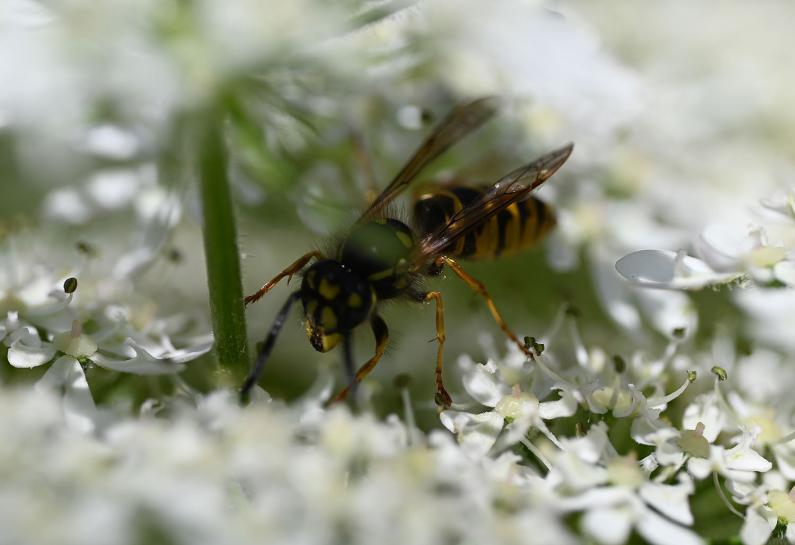
German Wasp

German Wasps are common throughout Britain, especially in the south.

Species introduction

At a glance
Latin name: 
Vespula germanica
Family: 
Social wasps
Family Latin name: 
VESPIDAE
Category: 
Insects other

Species description

Species description

The German Wasp is very similar to the Common Wasp, although it is slightly larger. Several features distinguish this wasp from the more common one, notably a solid band of yellow immediately behind each eye. These wasps are common throughout Britain, especially in the south, and can be found in most habitats throughout the summer months.

Species photographs

Larger photograph(s) (click to magnify)

Details

Species family information

Wasps have a slender, smooth body, and legs with relatively few hairs. Some are social and some solitary. In social wasps’ nests there is one breeding female only, the queen. Hornets are the largest of the social wasps, usually building papery nests in hollow trees. Despite their large size, they are not particularly aggressive, and should just be left alone. They are mostly brown and yellow, whereas most wasps are black and yellow. Wasps have biting mouthparts and antennae with 12 or 13 segments. They are normally winged. Unlike bees, wasps have pointed lower abdomens, and a narrow ‘waist’ separating the abdomen from the thorax. They are generally predatory or parasitic, and their stingers have few barbs, making them easy to pull out of victims so they can sting again. As key predators of other invertebrates they are extremely important in maintaining a balanced ecosystem. The large Vespidae family includes nearly all the social wasp species.

Category information

Insects evolved in the Ordovician from a crustacean ancestral lineage as terrestrial invertebrates with six legs (the Hexapoda). This was the time when terrestrial plants first appeared. In the Devonian some insects developed wings and flight, the first animals to do so. An early flying group was the Odonata from the Carboniferous, the damselflies and dragonflies, which have densely-veined wings and long, ten-segmented bodies. They are day-flying carnivores, with an aquatic larval stage, so are commonly seen flying near water. The carnivorous larvae are called nymphs. Odonata species are short-lived, damselflies surviving for 2-4 weeks, dragonflies for up to 2 months.

Some insect groups in the Cretaceous co-evolved with the flowering plants, and they have had a close association ever since. These groups are the Hymenoptera (bees, wasps, and ants), the Lepidoptera (butterflies and moths), the Diptera (flies), and the Coleoptera (beetles). The diversity of beetles is astonishing. Of all the known animal species on the planet, one in five is a beetle!