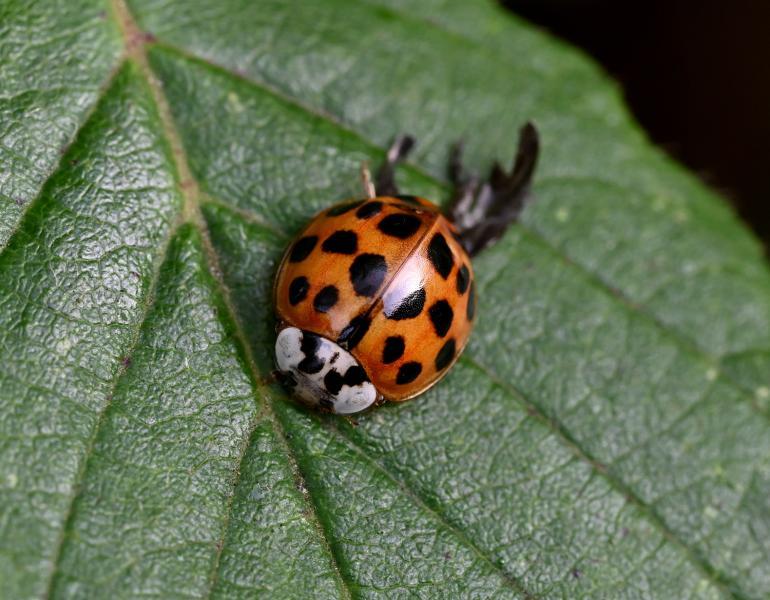
Harlequin Ladybird

The Harlequin Ladybird has a very varied appearance, both in colour and in the number of spots.

Species introduction

At a glance
Latin name: 
Harmonia axyridis
Family: 
Ladybirds
Family Latin name: 
COCCINELLIDAE
Category: 
Insects other
Vernacular names: 

Asian ladybird, Multicoloured ladybird, Asian lady beetle

Species description

Species description

The Harlequin Ladybird has a very varied appearance, both in its colour and in the number of spots different individuals have. They can be red, orange or even black, with black or red spots that number anything up to 19. They usually have orange on the underneath with orange legs. They are relatively large ladybirds.

This is an established species after it was introduced into Britain in 2004. It was introduced into Europe and North America from China, Russia and the far east where it is variously known as the Multi-coloured Asian Ladybird or the Asian Ladybird. This introduction was in order to control aphids.

It is a voracious predator and can strip plants of aphids far more quickly than other ladybird species can. It is thus a competitor to our native species and can rightly be classed as an invasive species. The Harlequin will also eat the eggs and larvae of other ladybirds.

Species photographs

Larger photograph(s) (click to magnify)

Details

Species family information

Ladybirds are popular aphid-eating beetles but are unpopular with predators because of their bitter taste. Avoid handling them as they secrete a foul-smelling liquid with a very persistent odour. They pass the Winter as dormant adults, and then are active from early Spring until late Autumn. There are 42 British species, whose patterns are variable. Eggs are mainly yellow or orange in colour, and laid in batches, taking 4-10 days to hatch depending on the temperature. In folklore many rhymes connected with divination for future partners mention ladybirds. If a single girl tosses a ladybird into the air, it will fly away in the direction a future lover lives. It is very unlucky to kill a ladybird, but lucky if one lands on you. If you kill any beetle, it will pour with rain.

Category information

Insects evolved in the Ordovician from a crustacean ancestral lineage as terrestrial invertebrates with six legs (the Hexapoda). This was the time when terrestrial plants first appeared. In the Devonian some insects developed wings and flight, the first animals to do so. An early flying group was the Odonata from the Carboniferous, the damselflies and dragonflies, which have densely-veined wings and long, ten-segmented bodies. They are day-flying carnivores, with an aquatic larval stage, so are commonly seen flying near water. The carnivorous larvae are called nymphs. Odonata species are short-lived, damselflies surviving for 2-4 weeks, dragonflies for up to 2 months.

Some insect groups in the Cretaceous co-evolved with the flowering plants, and they have had a close association ever since. These groups are the Hymenoptera (bees, wasps, and ants), the Lepidoptera (butterflies and moths), the Diptera (flies), and the Coleoptera (beetles). The diversity of beetles is astonishing. Of all the known animal species on the planet, one in five is a beetle!