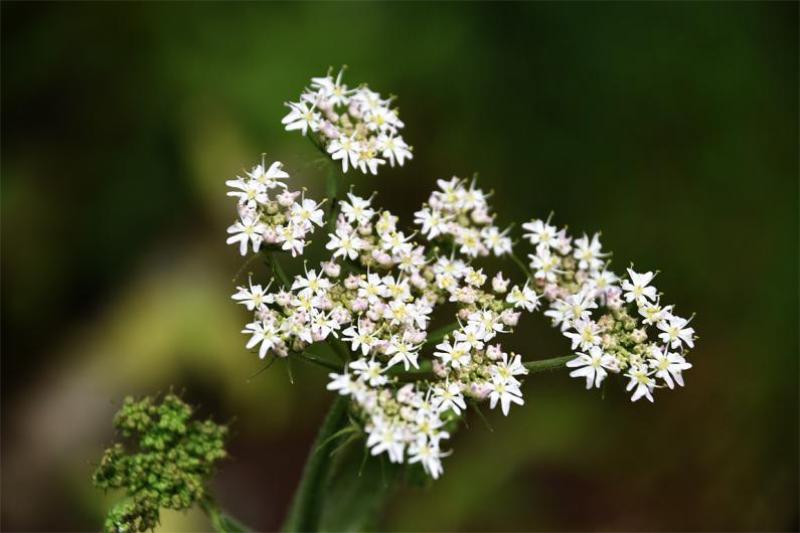
Hogweed

The Hogweed is a tough native that is beginning to dominate areas of the cemetery.

Species introduction

At a glance
Latin name: 
Heracleum sphondylium
Family: 
Umbellifers
Family Latin name: 
APIACEAE or UMBELLIFERAE
Category: 
Flowering Plants
Vernacular names: 

Cow parsnip, Bilders, Caddy, Eltrot, Limperscrimps, Cow-weed, Kirk, Chirk, Keks

Species description

Species description

You can't keep a good hogweed down, and in some seasons this tough native has been known to dominate areas of the cemetery; in other years, it is barely visible. Our native hogweed begins flowering when about 2 metres high, in April, and should not be confused with the Giant Hogweed, an introduced relative that reaches 4 metres in height before flowering.

Hogweed is often said to smell like pigs, hence the name. It was also a valuable food source for pigs, and science has demonstrated the plant's nutritional quality. More relevant in pig-less Heene Cemetery is that Hogweed (in its prolific years) is a tremendous food source to pollinating insects, especially hoverflies and parasitic wasps. Various species of beetle also benefit from this plant.

The UK Pollinator Monitoring Scheme has recorded 408 different species interacting with this plant. At 23, it has one of the highest averages among British plants and flowers for 10-minute Flower-Insect Timed Counts (FIT counts), only beaten by Common Ivy.

Species photographs

Larger photograph(s) (click to magnify)

Details

Species family information

These are mostly aromatic herbaceous plants with alternate feather-divided leaves that are sheathed at the base. The family contains both useful edible members and intensely poisonous ones, so correct identification before harvesting is vital.

Category information

Nucleic multicellular photosynthetic organisms lived in freshwater communities on land as long ago as a thousand million years, and their terrestrial descendants are known from the late Pre-Cambrian 850 million years ago. Embryophyte land plants are known from the mid Ordovician, and land plant structures such as roots and leaves are recognisable in mid Devonian fossils. Seeds seem to have evolved by the late Devonian. The Embryophytes are green land plants that form the bulk of the Earth’s vegetation. They have specialised reproductive organs and nurture the young embryo sporophyte. Most obtain their energy by photosynthesis, using sunlight to synthesise food from Carbon Dioxide and Water.

The earliest known plant group is the Archaeplastida, which were autotrophic. Listing just the surviving descendants, which evolved in turn, we have the Red Algae, the Chlorophyte Green Algae, the Charophyte Green Algae, and then the Embryophyta or land plants. The earliest embryophytes were the Liverworts, followed by the Hornworts, and the Mosses. Then we have the Vascular Plants, the Lycophytes and Ferns, followed by the Spermatophytes or seed plants, the Gnetophytes, Conifers, Ginkgos, and Cycads, and finally the Magnoliophyta (Angiosperms) or flowering plants.