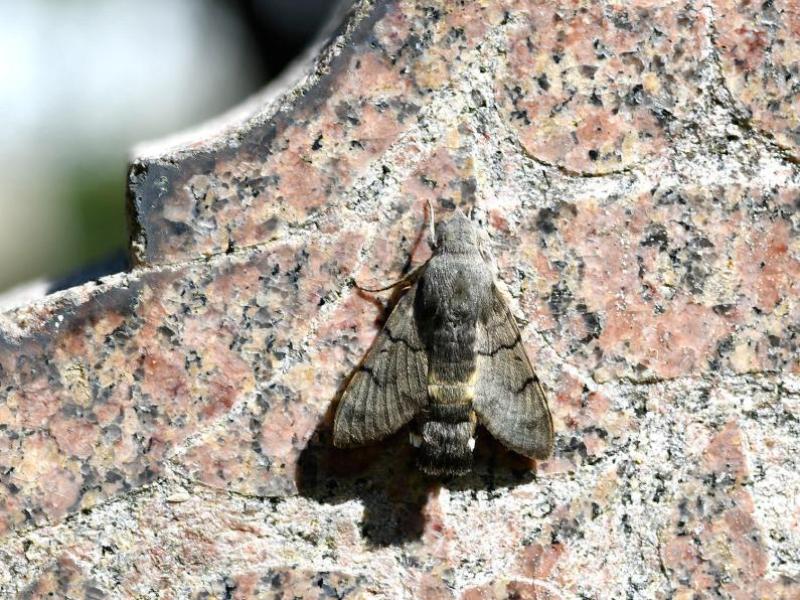
The first members of the insect group Lepidoptera, commonly called the Butterflies and Moths, almost certainly evolved from the Trichoptera (Caddisflies), somewhere between 140 and 200 MYA (million years ago). This is supported by genetic comparisons of extant Trichoptera and Lepidoptera. The divergence took place on the Pangaea supercontinent, before it broke apart, and this explains why so many Lepidoptera groups are found on more than one continent. Lepidoptera fossils are known from the Paleocene, a time when flowering plants had already diversified, for the Lepidopteran groups had and still have a strong dependence on them. These fossils greatly resemble living counterparts. All Lepidoptera currently referred to as butterflies share a common ancestor with the Plume Moths (Pterophoridae). Further genetic lines of moths developed, so ‘butterflies’ are not really a distinct group from moths at all, and the words ‘butterfly’ and ‘moth’ have no biological distinction. Biologically speaking all ‘butterflies’ are in fact moths, so the Lepidoptera should simply be referred to as the Moths. All ‘butterflies’ happen to be day-flying, but so are some moths, although the majority of the latter in the British Isles are nocturnal.
Lepidopterans have a 4-stage metamorphosis, egg, larva, pupa, and adult. As adults their life-span is short, from a few days for the Common Blue to ten months or more for the Brimstone and Peacock. They use their senses of smell and taste to locate and identify the correct caterpillar food plant on which to lay their eggs. Depending on the species resident butterflies can overwinter as any of the four metamorphic stages. Those that cannot overwinter will migrate here from the south, breed, and then die or return.
We have fewer than 70 butterflies, but many hundreds of other moths, some day-flying, most nocturnal. Warm, still days are the best days to observe day-flying moths; you can gently tap leaves and flowers to reveal more. The best way to study the nocturnal moths is by using a mercury vapour moth-trap in the summer months.
The word ‘butterfly’ probably comes from the yellow Brimstone. Butterflies in folklore, arising as they do from caterpillars, are symbolic of transformation, renewal, and rebirth. They are also equated with the human soul, either as the souls of the departed, or as the souls of babies yet to be born. The Greek word for butterfly is ‘psyche’. Stillborn babies were thought to turn into butterflies after burial. The butterfly is a popular motif in art and jewellery, and in literature is well known in its caterpillar form, such as in Alice in Wonderland, and in Eric Carle’s children’s book ‘The Very Hungry Caterpillar’.
If three butterflies are seen together it is an omen of misfortune. If the first butterfly seen in the year is white you will eat white bread for the rest of the year. This was welcomed because white bread used to be the most expensive. Thus, if the first butterfly seen in the year was brown then the unlucky observer would eat common or garden brown bread for the rest of the year. Sadly, it was considered good luck to kill the first butterfly seen in the year. A butterfly seen flying at night is a death omen.