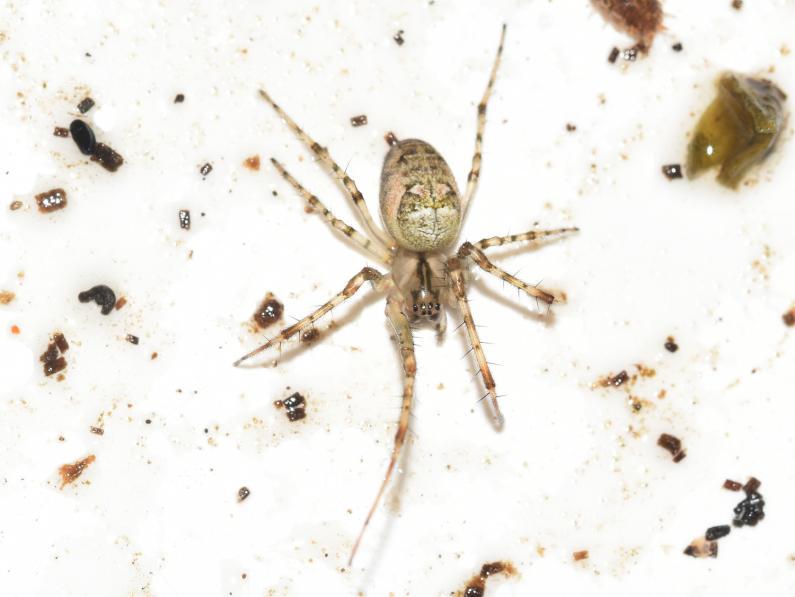
Arachnids, of which spiders are the most numerous but just one of many types, are silk-producing joint-legged invertebrates whose ancestors evolved during the Devonian. Invertebrates with jointed limbs are called arthropods. One of these ancestral groups, the Chelicerata, shared a common ancestor with the Antennulata, a group that gave rise to the Crustacea, the group to which insects are now known to belong. Insects are therefore six-legged crustaceans! Arachnids, which evolved along a different lineage, are a very diverse group, including spiders, mites and ticks, whip spiders, scorpions, whip scorpions, harvestmen, and many other types.
Most arachnids have a segmented body divided into two regions, of which the front part has four pairs of legs but no wings or antenna. This distinguishes them clearly from insects, which have three segments to the body and three pairs of legs. The front part (head and thorax) of the arachnid body has pincers, mouth parts, and legs, the rear part (abdomen) has sensory, genital, and silk-spinning appendages. The fine hairs that cover the body give arachnids their sense of touch. They are largely terrestrial and solitary, coming together just for mating. Most are carnivorous, feeding off the body fluids of their prey, or covering it with their own internally produced digestive fluids to convert the prey to liquid form, which is then sucked up.
Unlike insects, young spiders hatch directly from the eggs, looking like miniature versions of the adults. They grow and reach maturity through a series of moults, and most will live about a year or a little longer. The most familiar spider’s web in the British countryside is the orb web, but there are many other designs, some geometric to a degree, others with a loose or random framework of criss-cross silk threads.
There is much folklore associated with spiders. If a spider lands on you then you will come into money, particularly if you are industrious like the spider. Little red spiders are called ‘money spiders’. The use of spiders to cure ague and whooping cough is too unpleasant to record here. Cobwebs wrapped around wounds stop bleeding and inhibit infection, a practice that has medical support. For the usefulness of its webs it was deemed unlucky to kill spiders, or to deliberately damage their webs.