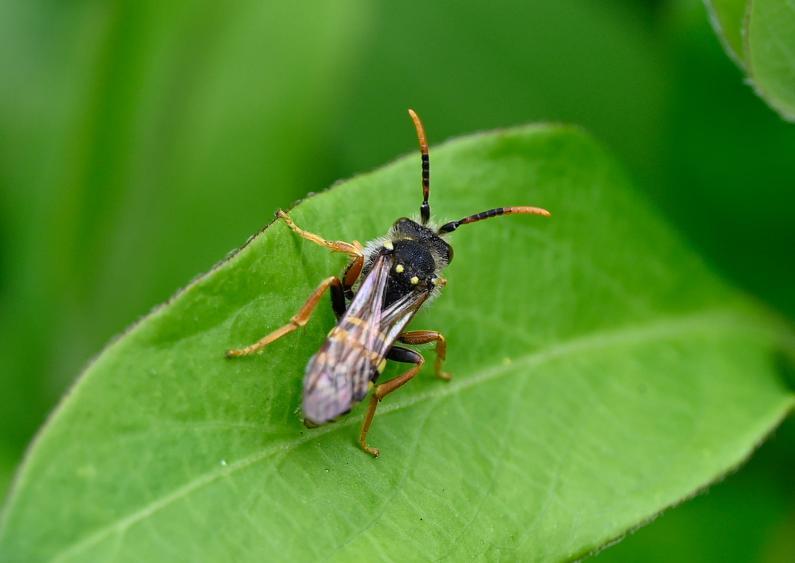
Nomad bee - unnamed 4

Large Nomad bee, undetermined species, mid-April 2025.

Species introduction

At a glance
Latin name: 
Nomada sp.
Family: 
Bumble and Honey Bees
Family Latin name: 
APIDAE
Category: 
Insects other

Species description

Species description

This Nomad bee resembles several others that have been seen in the Cemetery. Although it has not been possible to provide a species identification for it (with its wings closed and hiding its abdominal markings), its markings and colouration, together with its larger relative size, are significantly different from those other individuals for us to class it as a separate species. It is nearly a good match for a Nomada goodeniana, but not sufficient for that species name to be applied here.

As with the majority of Nomad bees (perhaps 850 different species worldwide and 34 known in the British Isles), this species (whichever one it might be) is cleptoparasitic, primarily on the Andrena family of bees.

Species photographs

Larger photograph(s) (click to magnify)

Details

Species family information

Nomad bees are a genus of small, relatively hairless bees that often resemble small wasps. They are between 4 and 9 millimetres in length. All Nomad bees steal from other species of bees. Females enter the host's nest burrow to lay eggs before any cells have been sealed up. When its grub hatches from the egg, it will devour the host egg or grub with its large jaws before feeding on the food store that the host parent had provisioned the cells with.

There are 34 species of British Nomad bees. Differentiating one from another requires considerable magnification - and knowledge.

The Nomada genus of bees belong to the Apidiae family, which are commonly known as Bumble and Honey Bees.

Category information

Insects evolved in the Ordovician from a crustacean ancestral lineage as terrestrial invertebrates with six legs (the Hexapoda). This was the time when terrestrial plants first appeared. In the Devonian some insects developed wings and flight, the first animals to do so. An early flying group was the Odonata from the Carboniferous, the damselflies and dragonflies, which have densely-veined wings and long, ten-segmented bodies. They are day-flying carnivores, with an aquatic larval stage, so are commonly seen flying near water. The carnivorous larvae are called nymphs. Odonata species are short-lived, damselflies surviving for 2-4 weeks, dragonflies for up to 2 months.

Some insect groups in the Cretaceous co-evolved with the flowering plants, and they have had a close association ever since. These groups are the Hymenoptera (bees, wasps, and ants), the Lepidoptera (butterflies and moths), the Diptera (flies), and the Coleoptera (beetles). The diversity of beetles is astonishing. Of all the known animal species on the planet, one in five is a beetle!