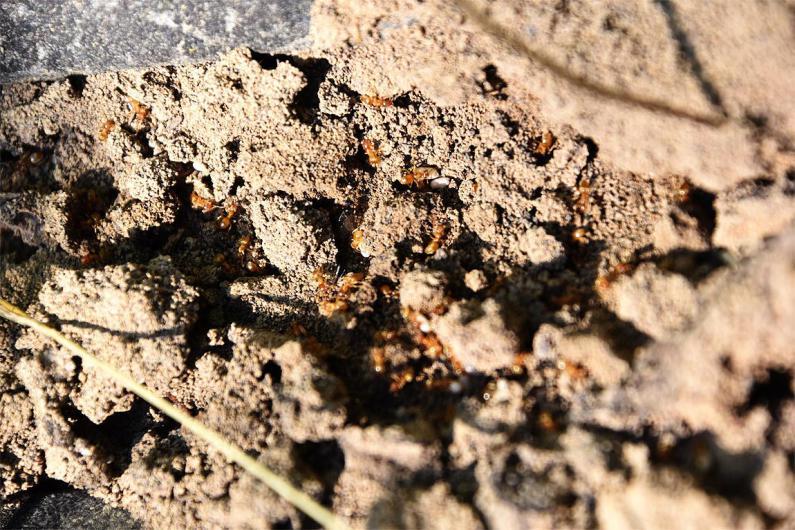
Red Ant

Red ants are active foragers, and more aggressive than black ants.

Species introduction

At a glance
Latin name: 
Myrmica rubra
Family: 
Ants
Family Latin name: 
FORMICIDAE
Category: 
Insects other

Species description

Species description

This is more common in the cemetery than the Black Garden Ant.  Red ants are active foragers, and more aggressive than black ants.  Their acid sting is more painful, but is no more than a temporary irritation.  They live in smaller colonies than the black ants.

Species photographs

Larger photograph(s) (click to magnify)

Details

Species family information

Ants, Wasps, and Bees are related, and in a huge insect group called the Hymenoptera. Ants have ‘elbowed’ antennae, and a node-like structure of one or two segments that distinguishes their slender waists. They are social, living in organised nests of many thousands. Only the queen is fertile, the female workers being sterile. Females do all the work in the nest, looking after the other ants, eggs, and larvae, tidying, and building extensions. They have a lifespan of about five years. Male ants are only born from special eggs laid by the queen in the Summer, along with new queen eggs. The males mate with new queens, after which they soon die, and the new queens leave, or are driven out by the incumbent queen, to found colonies of their own. The departing queens and the winged males are called ‘flying ants’ and are only seen in the Summer. Ants are omnivorous, eating other insects, fruit, and nectar, but probably their favourite food is the sugary secretion of sap-sucking insects, and they will herd and farm aphids to get this secretion, or ‘honeydew’. 

This widespread family of nest-building ants has a profound effect on soil structure.

Category information

Insects evolved in the Ordovician from a crustacean ancestral lineage as terrestrial invertebrates with six legs (the Hexapoda). This was the time when terrestrial plants first appeared. In the Devonian some insects developed wings and flight, the first animals to do so. An early flying group was the Odonata from the Carboniferous, the damselflies and dragonflies, which have densely-veined wings and long, ten-segmented bodies. They are day-flying carnivores, with an aquatic larval stage, so are commonly seen flying near water. The carnivorous larvae are called nymphs. Odonata species are short-lived, damselflies surviving for 2-4 weeks, dragonflies for up to 2 months.

Some insect groups in the Cretaceous co-evolved with the flowering plants, and they have had a close association ever since. These groups are the Hymenoptera (bees, wasps, and ants), the Lepidoptera (butterflies and moths), the Diptera (flies), and the Coleoptera (beetles). The diversity of beetles is astonishing. Of all the known animal species on the planet, one in five is a beetle!